
.png)
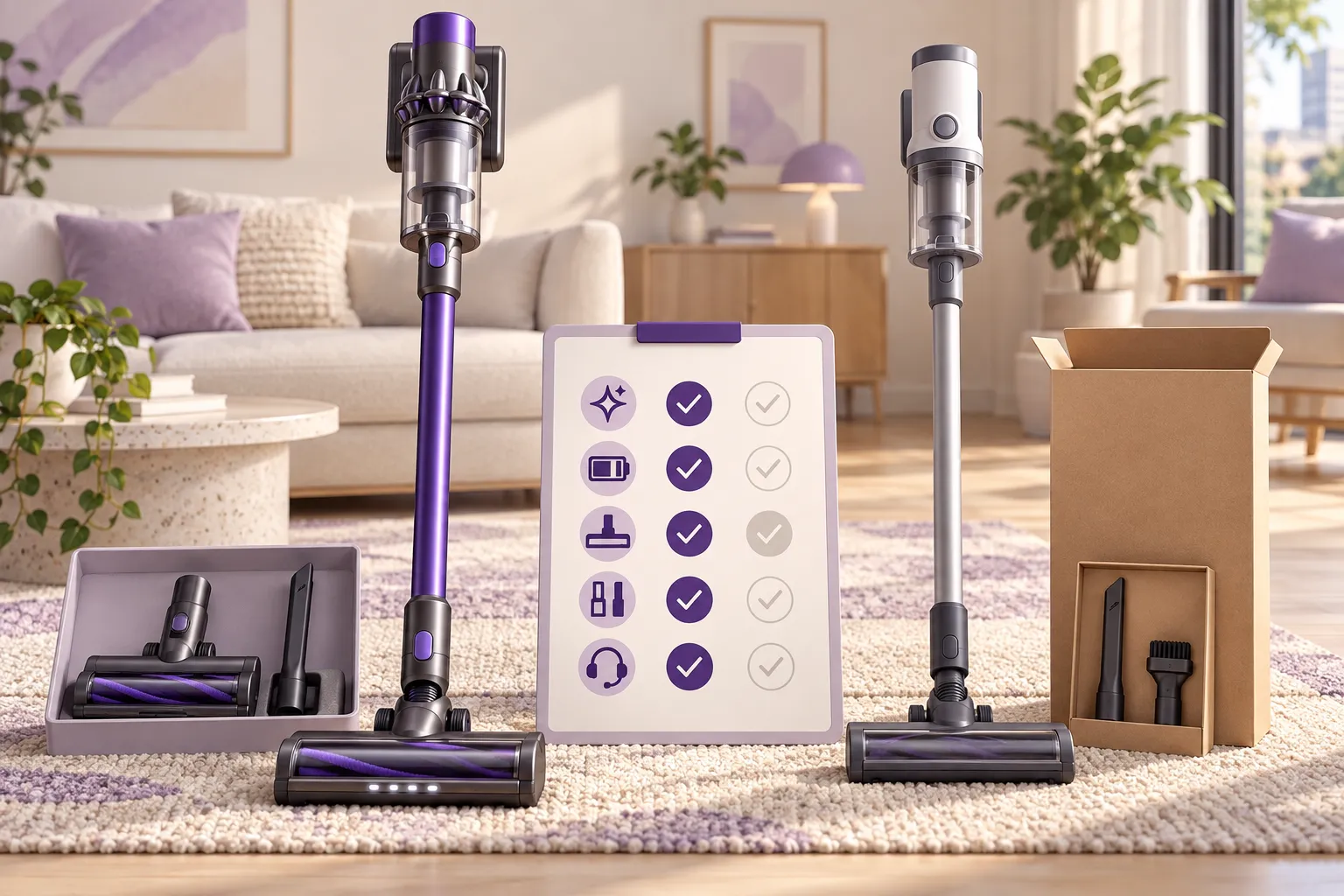
Neither option is automatically better. A refurbished Dyson can be the stronger buy when its exact condition, battery, floor head, accessories and after-sale support are clearly documented. A new budget stick vacuum can be the safer choice when you want a simple purchase, predictable inclusions and a straightforward retailer support path.
The useful comparison is not “premium versus cheap”. It is one specific refurbished machine against one specific new machine, for your floors, home size and cleaning habits.
Start with the job the vacuum must do
Before comparing brands or prices, write down what the machine needs to handle. A small hard-floor apartment, a carpeted family home and a house with long pet hair place different demands on a vacuum.
- Floor mix: hard floors, rugs, low-pile carpet or thicker carpet.
- Cleaning area: one quick room or a full-home clean.
- Mess: fine dust, crumbs, long hair, pet hair or larger debris.
- Storage: wall dock, cupboard height and charging-point access.
- Tools: which floor head and small attachments you will actually use.
Do not assume a tool fits because two vacuums look similar. For a Dyson, identify the exact model and check its official guide or manual before relying on attachment, battery, filter or maintenance compatibility.
Refurbished Dyson versus new budget vacuum: the quick answer
| Question | Refurbished Dyson | New budget stick vacuum |
|---|---|---|
| What exactly are you buying? | A used machine whose value depends heavily on condition, testing and included tools. | A new machine with a stated model, box contents and retailer listing. |
| What should you verify? | Battery behaviour, charging, floor-head operation, bin, seals, filters, tools and written support. | Floor suitability, expected runtime for the listed mode, tool set, consumable availability and support terms. |
| What is the main uncertainty? | The machine's previous use and the depth of the refurbishment. | Whether a lower-cost model meets your real cleaning needs over time. |
| Who is it best for? | A buyer comfortable checking one specific machine and valuing its model, tools and serviceability. | A buyer prioritising a simple new purchase and clear retailer documentation. |
When does a refurbished Dyson make more sense?
A refurbished Dyson becomes compelling when the seller can answer specific questions about the actual unit—not just describe a generic refurbishment process.
1. The exact model suits your home
Model name matters because size, controls, compatible tools and maintenance steps vary. Ask for the exact model and confirm what is included. A low advertised price is less useful if the floor head or tool you need is missing.
2. The seller explains what was checked
“Tested” should mean more than “it turns on”. Ask whether it charges, runs consistently, operates through its available modes, drives the supplied floor head and closes securely at the bin. Ask what was cleaned, what was replaced and what remains original.
3. You can assess the battery without invented promises
There is no honest universal runtime promise for every used machine. Runtime changes with model, mode, attachment, floor resistance and battery condition. Ask how the battery was assessed and whether any written result or replacement detail is available. Be cautious when a seller gives a precise “as new” claim without explaining how it was established.
4. The after-sale support is written down
Check the guarantee or warranty period, what it covers, exclusions, who pays transport and how a claim is made. Dusti's current refurbished vacuum shop says its machines are tested and deep cleaned and include a 12-month guarantee; buyers should still confirm current stock, the condition of the particular unit, included accessories and the guarantee terms before ordering.
When is a new budget stick vacuum the better choice?
A new budget vacuum may be the better decision when the specific product meets your floor and cleaning needs and you place more value on purchase simplicity than on owning a particular premium model.
- You want the exact box contents and support terms stated by a retailer.
- Your cleaning area is modest and the machine's documented capability is enough.
- You do not already own compatible tools or accessories that influence the decision.
- You would rather avoid assessing the history of a used battery and floor head.
“New” is not a performance guarantee. Read the manual, check which floor types the supplied head is intended for, look at how consumables are obtained and confirm the returns and support process before paying.
Use this seven-question comparison before you buy
- What are the exact model numbers? Compare named models, not “refurbished Dyson” with “budget vacuum”.
- What is included? List the floor head, charger, dock and small tools for each option.
- Does the main head suit your floors? Confirm this from the manufacturer documentation.
- What evidence is provided for the refurbished unit? Ask what was tested, cleaned or replaced.
- How will you get filters, batteries or other consumables? Check availability for the exact model rather than assuming.
- What happens if something goes wrong? Compare the written support and claim process, including transport.
- What is the total cost to make it useful? Include missing tools, delivery and any immediate consumables—not just the sticker price.
What should you avoid?
Walk away from a comparison that depends on vague labels. “Refurbished”, “professionally cleaned”, “like new” and “premium” do not tell you what was done to one physical machine. Equally, “new” and “budget” do not tell you whether the supplied floor head, battery behaviour or tool set suits your home.
Also avoid buying a different vacuum before checking whether your existing one needs replacement at all. If it has changed suddenly—poor pickup, pulsing, charging trouble, a stopped floor head or visible damage—an assessment may clarify whether service or repair is the better route.
What if you already own a Dyson?
If your current machine otherwise suits your home, compare three real numbers: the cost to assess it, the likely additional repair or parts cost after diagnosis, and the complete replacement cost.
Dusti's current service is A$95. Optional Melbourne pickup and return is A$30, making the combined booking A$125 within the listed service area. Replacement parts and fault-specific repair work may cost extra. You can check pickup information or tell Dusti your model and symptoms before assuming the service includes a particular repair.
The bottom line
Choose the refurbished Dyson when the exact unit is transparent, suitable and properly supported. Choose the new budget vacuum when its documented capability is enough and the simpler purchase matters more. The best value is the machine that performs the work you need without hidden accessory, condition or support gaps.
Dusti is an independent repair and refurbished-vacuum business and is not affiliated with Dyson. Prices and shop information checked 9 October 2026. The header artwork is an illustration, not a photograph of a Dusti repair, employee, workshop or customer home.

